Indoor guinea pig cages, playpens and hutches compared
Indoor guinea pig cages, playpens and hutches compared: which give a pair the 1 m² they need, and what to check before you buy in Australia.
Indoors, a pair of guinea pigs needs at least 1 m² of flat floor. RSPCA Australia recommends at least 2 m × 0.5 m. A 140 × 70 cm solid-panel playpen (about 0.98 m²) gets close. Most pet-shop cages are 0.5–0.72 m², and furniture-style indoor hutches are often only about 0.53 m². Always check the internal floor size, not the box label.
Ready-made indoor guinea pig enclosures range from great to far too small, even with “guinea pig” on the box. This guide compares the three main types and what to check before you buy.
Are store-bought guinea pig cages big enough?
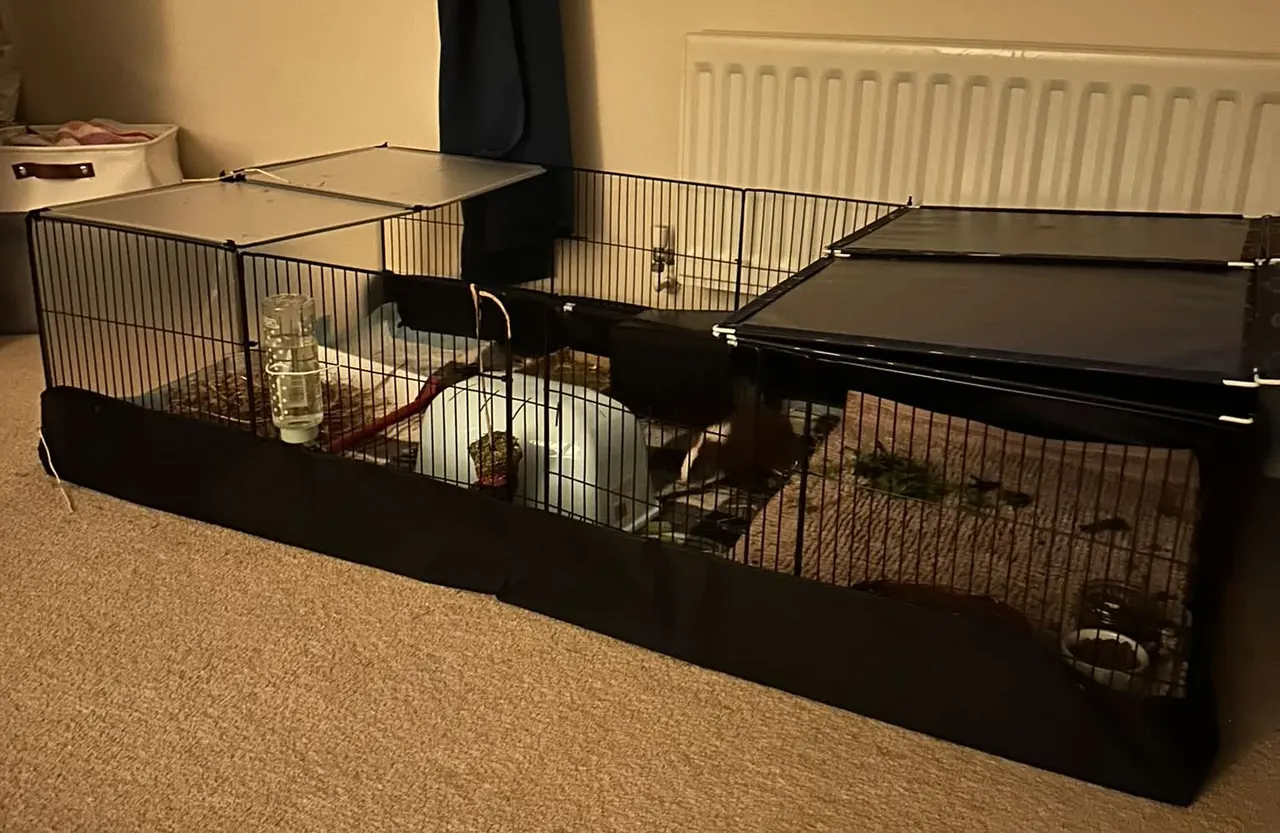
Most are not. A classic pet-shop cage, with a deep plastic tray and a clip-on wire top, is usually well under 1 m² of floor, and many are around 0.5 m², which is roughly half of what a pair needs.
Good points
- Easy to find and quick to set up.
- The deep base keeps bedding inside.
- Comes with a lid, which helps if you have other pets.
Watch out for
- Most are well under 1 m², and many are around 0.5 m².
- Small doors make cleaning and handling awkward.
- You can't make them bigger.
What to check: the internal floor dimensions. A cage of about 120 × 60 cm gives around 0.72 m². That meets the bare minimum of about 0.7 m² that Humane World for Animals gives for one or two pigs, but not RSPCA Australia’s guidance of 2 m × 0.5 m (about 1 m²) for a pair. Some owners join two identical cages together to double the space. If you already own a small cage, see is my guinea pig cage too small? for cheap upgrades.
Is a playpen good for guinea pigs indoors?
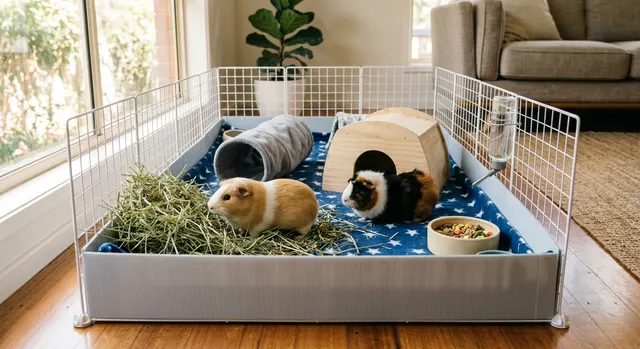
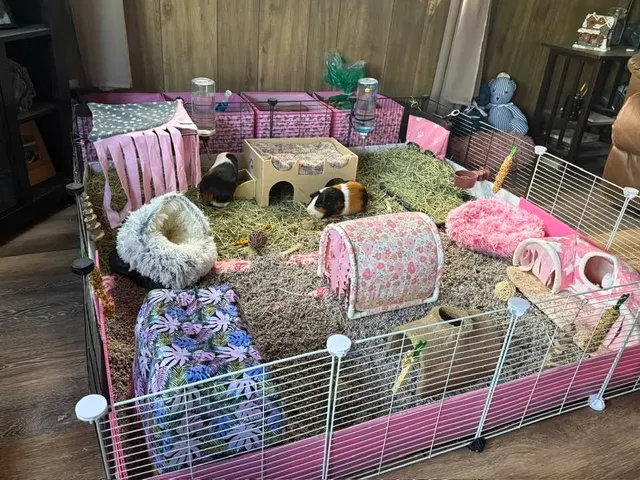
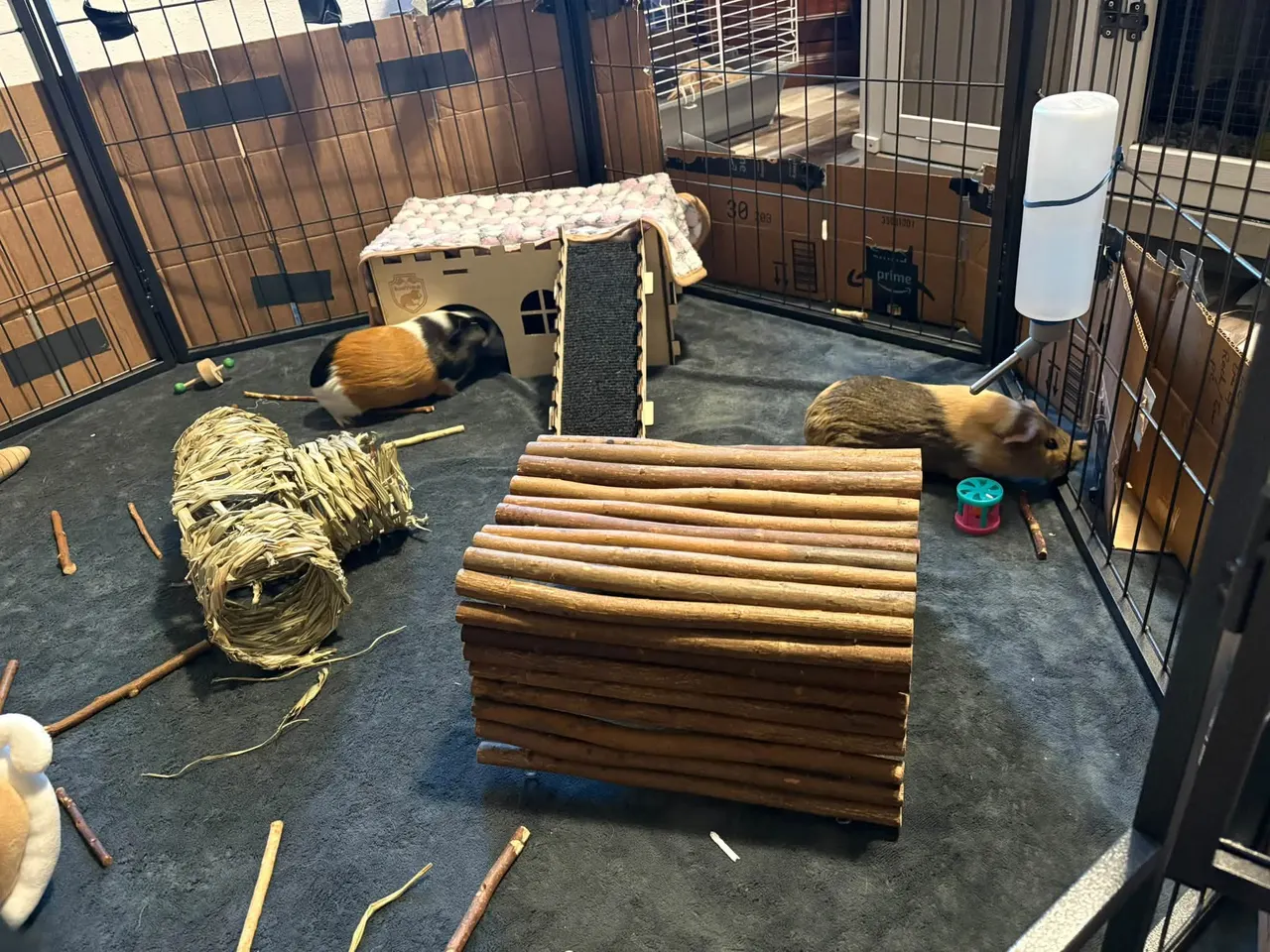
Yes. A solid-panel playpen is one of the best-value indoor enclosures, because it gives a lot of floor for the price. A 140 × 70 cm pen gives about 0.98 m², close to the recommended size for a pair, and many owners use one as a full-time indoor enclosure.
Playpens made from solid plastic panels, often with a waterproof floor mat, are now easy to find in Australia.
Good points
- Plenty of floor space for the price.
- Solid walls keep bedding in and block draughts.
- Can often be reshaped into an L or extended with extra panels.
Watch out for
- Usually no lid, so not suitable where cats or dogs can reach.
- Light panels can shift if they aren't clipped together firmly.
- Check the walls are at least 30 cm high.
For panel, wire and fabric pens compared, how to work out floor area from the panel count, and what to put underneath, see our guinea pig playpen guide. For a DIY option with even more floor for the money, see our C&C cage guide.
Are indoor wooden hutches worth it?
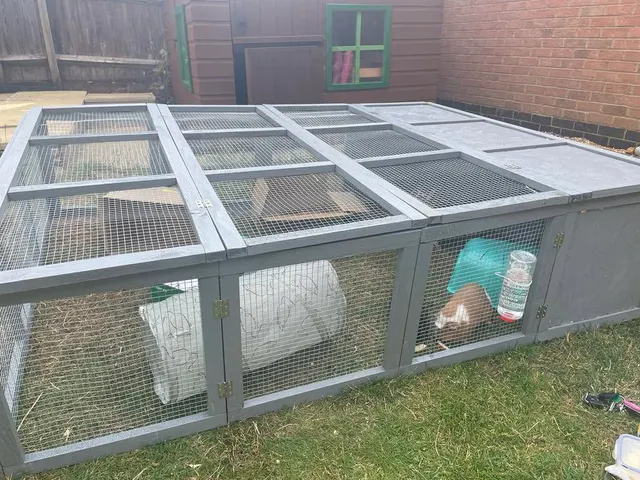
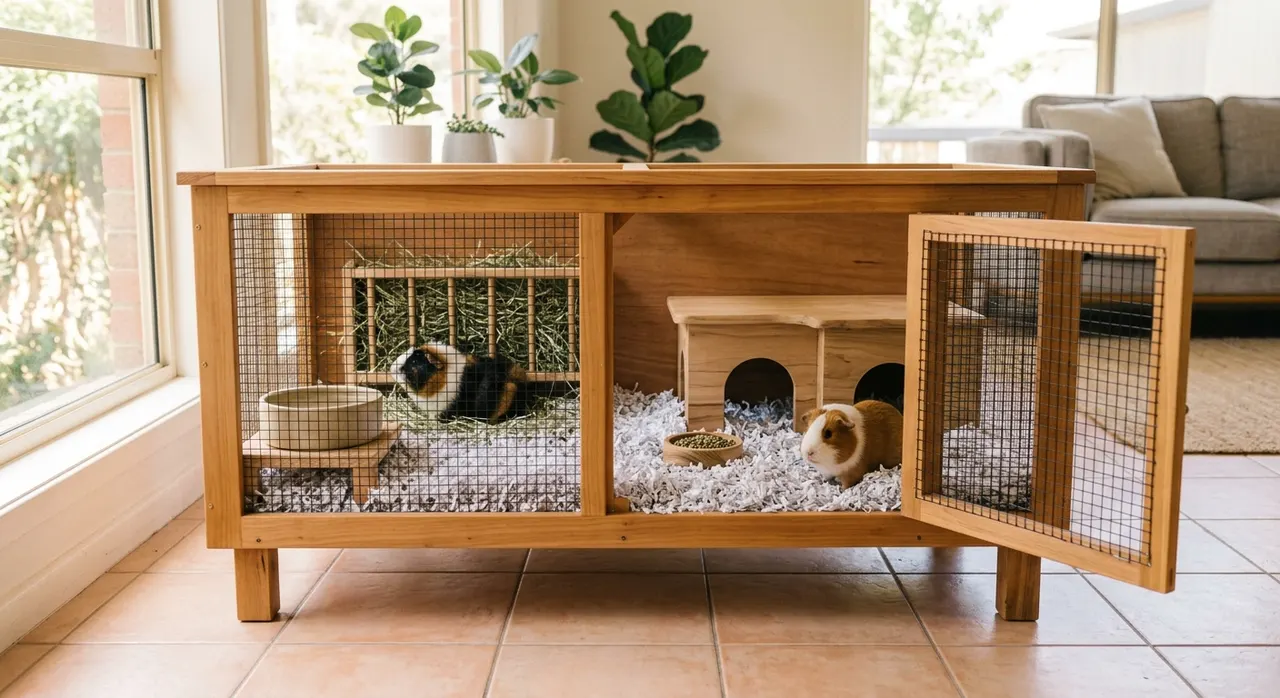
Only if the floor is big enough, and most furniture-style hutches are not. They trade floor space for looks: a typical raised indoor hutch of about 96 × 55 cm gives only about 0.53 m², around half of what a pair needs.
If you love the look, choose the largest single-level floor you can find, and treat any upper level as a bonus. Avoid hutches where most of the space is split across stacked levels joined by steep ramps. Our guide to lofts and ramps explains why extra levels don’t count as floor space.
What should I check before buying an indoor guinea pig cage?
Check the internal floor size first, then the floor surface, wall height and access. These points come from RSPCA Australia’s housing advice, which recommends a rectangular enclosure at least 30 cm high, no wire floors and places to hide.
- At least 1 m² of flat floor for a pair (use our size calculator for other group sizes)
- A solid floor with no wire mesh underfoot
- A rectangular shape with room for a proper run
- Walls at least 30 cm high, and a lid if other pets are around
- Big openings for easy cleaning and gentle handling
- Room for a hide per pig, a hay rack, water and a food bowl without crowding
Where can I compare indoor cages sold in Australia?
Our researched picks show how specific indoor cages sold in Australia measure up, and the comparison table compares every housing type side by side. If you’re still deciding between indoor and outdoor housing, read indoor vs outdoor guinea pigs in Australia.
Frequently asked questions
What is the best indoor enclosure for two guinea pigs?
expand_more
For most owners, a solid-panel playpen or a C&C cage gives the most floor for the money. A 140 × 70 cm playpen gives about 0.98 m², close to the 1 m² a pair needs. Most pet-shop cages with a plastic base and wire top are well under 1 m², and furniture-style indoor hutches are often only about 0.5 m².
Are pet shop guinea pig cages big enough for two?
expand_more
Usually not. Most plastic-base cages with a wire top are well under 1 m² of floor, and many are around 0.5 m². A large 120 × 60 cm cage gives about 0.72 m², which meets the bare minimum but not RSPCA Australia's guidance of 2 m × 0.5 m, or about 1 m², for a pair.
Can I use a playpen as a permanent guinea pig cage?
expand_more
Yes. Many owners use a solid-panel playpen as a full-time indoor enclosure. Choose one with walls at least 30 cm high, clip the panels together firmly and put a waterproof layer underneath. Most playpens have no lid, so only use one where cats and dogs can't reach your guinea pigs.
Are indoor wooden hutches good for guinea pigs?
expand_more
They can be, but check the floor size first. A typical raised indoor hutch of about 96 × 55 cm gives only about 0.53 m², around half of what a pair needs. Upper levels don't count as floor space. Choose the largest single-level floor you can find, and avoid designs split across stacked levels with steep ramps.
Do indoor guinea pig cages need a lid?
expand_more
Only if other pets can reach them. RSPCA Australia says a roof may be needed if guinea pigs are at risk from dogs, cats or birds of prey. In a room with no other pets, an open-top pen or cage with walls at least 30 cm high is fine, and it's easier to clean.
Can guinea pigs live on a wire cage floor?
expand_more
No. RSPCA Australia advises avoiding wire floors because they can cause injuries and foot infections, and Humane World for Animals lists wire-floor cages as unsuitable. Choose a solid floor, and cover it with dust-free bedding such as paper-based litter, hay or washable fleece.
Want a properly sized cage without the DIY?
We're looking at bringing properly sized cages and C&C kits to Australia. Join the waitlist and tell us what you'd want.
This guide is general information to help you compare housing options. It isn't veterinary advice. If your guinea pig seems unwell, contact a vet experienced with exotic pets.