Is my guinea pig cage too small? Signs and cheap ways to upgrade
How to tell if your guinea pig cage is too small, how to measure it properly, and five cheap ways to upgrade a pet-shop cage without starting again.

Measure the inside floor: length × width in cm ÷ 10,000 = m². A pair of guinea pigs needs at least 1 m² of flat, single-level floor. Many pet-shop cages give only 0.4–0.7 m². If yours is smaller than that, you can upgrade cheaply by attaching a playpen, joining two cages, or switching to a C&C cage.
If you’ve already bought a cage and just found out it may be too small, you’re not alone. Most cages sold for guinea pigs in Australia are smaller than welfare guidance recommends, but you usually don’t need to throw yours out or spend a lot to fix it.
Step 1: Measure your cage properly
- Measure the internal floor: the length and width of the base your pigs actually walk on. Ignore lofts, shelves and ramps.
- Multiply length × width in cm.
- Divide by 10,000 to get square metres.
Example: a cage with a 100 × 50 cm base = 5,000 cm² = 0.5 m². That’s half of what a pair needs.
Compare your number with this table (from our cage size guide):
| Guinea pigs | Bare minimum | Recommended |
|---|---|---|
| 2 | 0.7 m² | 1.0 m² |
| 3 | 1.0 m² | 1.2 m² |
| 4 | 1.2 m² | 1.5 m² |
Or put your numbers into our size calculator.
Why so many cages are too small
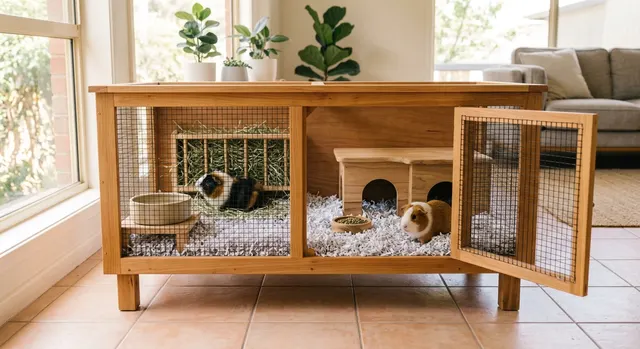
Cage labels like “large” or “suits rabbits and guinea pigs” don’t have to meet any standard. Many common indoor cages are 80–120 cm long and 50–60 cm wide, which gives about 0.4–0.7 m² of floor. Tall multi-level cages can look big, but loft levels don’t count as floor space.
Always check listings for the base dimensions, not just the overall size.
Signs your guinea pigs need more space
Measurements are the most reliable test, but your pigs’ behaviour can tell you too:
- They rarely run, "zoom" or popcorn in the cage, but do during floor time
- Squabbling, chasing, teeth chattering or mounting, especially between boars
- Chewing the cage bars
- Barbering (chewing each other's fur) or overgrooming
- Weight gain and sitting in one spot most of the day
- The cage gets wet and smelly very fast, because there's nowhere clean to rest
These can have other causes, including illness, so check with a vet if a pig seems unwell.
5 cheap ways to upgrade a small cage
1. Attach a playpen
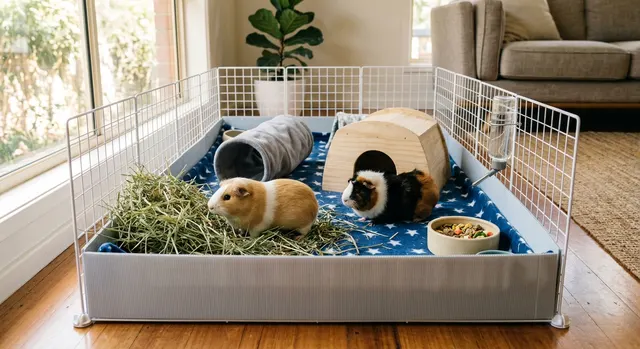
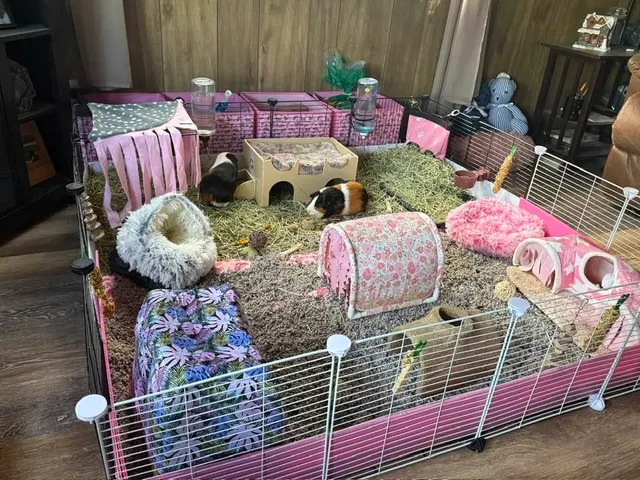
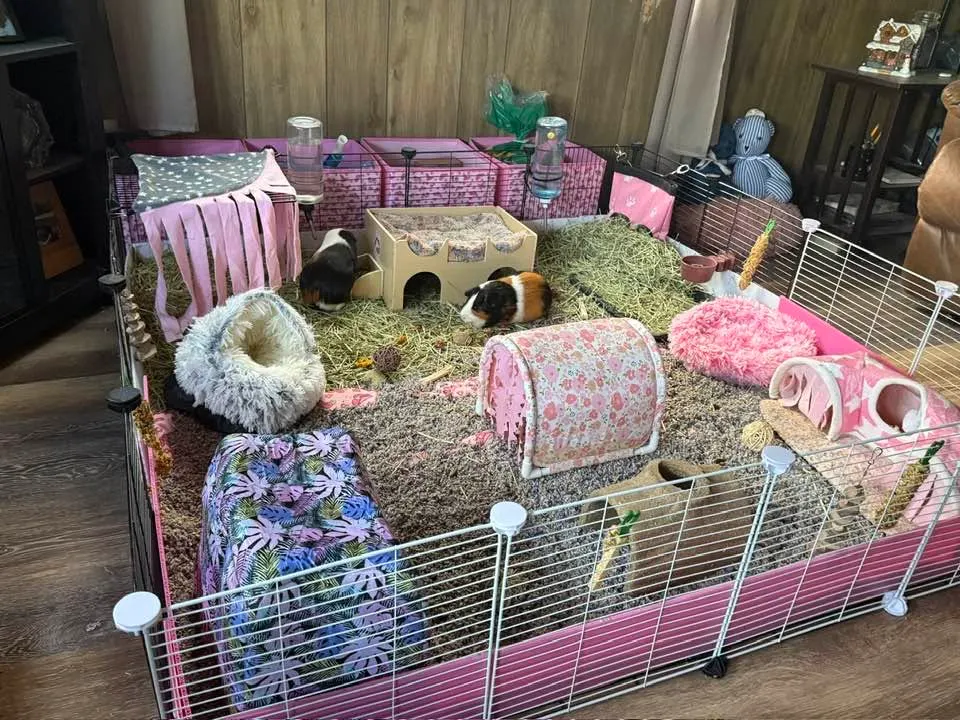
Take the door off, or lift off the top, and put the cage inside or next to a pen of grid panels. It becomes the “bedroom” and the pen becomes the living space. Even a small square of eight 35 cm grid panels (2 × 2 grids, about 0.5 m²) roughly doubles the floor of a typical pet-shop cage. Put down a waterproof base such as Corflute, lino or a shower curtain under fleece. See our playpen guide.
2. Switch to a C&C cage
Storage grids and a Corflute sheet make a 2 × 4 cage of about 1 m², often for less than a pet-shop cage. See C&C cages and our DIY build guide.
3. Join two cages
Some cage brands have removable ends or side doors, so you can connect two cages with a tunnel or remove the adjoining walls. Make sure the join is wide and secure, and that there’s no gap or sharp edge.
4. Use the cage base only
Many plastic-based cages come apart. Use the deep plastic base as a litter area or bedroom inside a larger grid enclosure, and put the wire top away.
5. Build a bigger floor around it
If you have space, a simple enclosure of grids on a waterproof base, with the old cage inside as a hide, gives your pigs a big upgrade for very little.
Our cheap guinea pig cages guide compares costs per square metre for each option.
What to do with the old cage
Don’t bin it. A small cage is useful as:
- A temporary pen while you clean the main cage
- A quarantine or sick-bay cage for a new or unwell pig
- A carrier backup for moving house. See guinea pig carriers and travel.
Is floor time enough?
Floor time is great for exercise and bonding, but it doesn’t replace a properly sized cage. Guinea pigs are most active around dawn and dusk, and they spend most of the day and night in their cage, often while you’re asleep or at work.
Frequently asked questions
How do I know if my guinea pig cage is too small?
expand_more
Measure the internal floor length and width in centimetres, multiply them and divide by 10,000 to get square metres. If a pair has less than about 1 m², the cage is too small. Behaviour signs include pigs rarely running or popcorning, squabbling, overgrooming, bar chewing and a cage that gets dirty and smelly very quickly.
Are pet shop guinea pig cages big enough?
expand_more
Many aren't. Common cages sold for guinea pigs in Australia are around 80 to 120 cm long and 50 to 60 cm wide, giving about 0.4 to 0.7 m² of floor. That's below what a pair needs. Some larger hutches and pens are big enough, so always check the floor size.
What size cage do 2 guinea pigs need?
expand_more
At least 1 m² of flat, continuous floor. That's about a 2 × 4 grid C&C cage (roughly 71 × 142 cm). RSPCA Australia recommends at least 2 m × 0.5 m for a pair. Bigger is better, especially for boars.
Is floor time enough if the cage is small?
expand_more
Daily floor time helps, but it doesn't make up for a cage that's too small. Guinea pigs spend most of their day and night in the cage, and they're most active around dawn and dusk when you may not be there. The cage itself needs enough room.
What is the cheapest way to make a guinea pig cage bigger?
expand_more
Usually converting to or adding a C&C cage made from storage grids and a Corflute base, or attaching a playpen to the existing cage. Both can roughly double floor space for around $100 to $150.
Can I keep using my small cage for anything?
expand_more
Yes. A small cage makes a handy temporary pen for cleaning day, a quarantine or sick-bay cage, or part of a bigger setup when you join it to a playpen. Just don't use it as your pigs' main home.
Want a properly sized cage without the DIY?
We're looking at bringing properly sized cages and C&C kits to Australia. Join the waitlist and tell us what you'd want.
This guide is general information to help you compare housing options. It isn't veterinary advice. If your guinea pig seems unwell, contact a vet experienced with exotic pets.