Outdoor hutch for guinea pigs: an Australian buying guide
What to check before buying an outdoor guinea pig hutch in Australia: real floor size, ramps, mesh, latches, timber, cleaning access and price ranges.
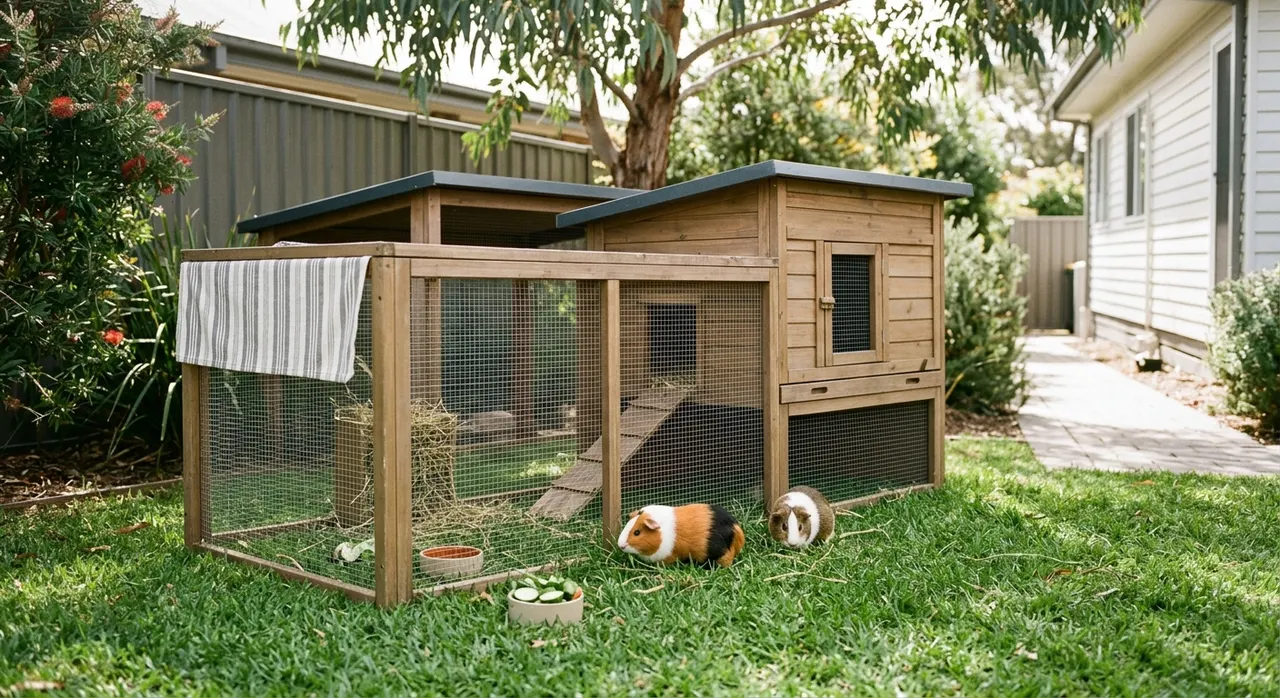
Before buying an outdoor guinea pig hutch, check that the enclosed hutch alone has at least 1 m² of flat floor for a pair (RSPCA Australia recommends at least 2 m × 0.5 m). Then check for a solid raised floor, welded mesh rather than chicken wire, two-step latches, a waterproof sloped roof and a roof or front that opens fully for cleaning.
Outdoor hutches are sold everywhere in Australia, from pet stores to hardware chains and online marketplaces. Many look great in photos but are much smaller or flimsier than they appear. This guide covers what to check in a listing before you buy.
If you haven’t yet decided whether your pigs should live outside, start with our guide to keeping guinea pigs outdoors safely, which covers shade, heat, predators and seasonal care.
How big should an outdoor guinea pig hutch be?
For a pair, the enclosed, weatherproof hutch should have at least 1 m² of flat floor on its own, with the run as extra space. RSPCA Australia recommends at least 2 m × 0.5 m for a pair, and the UK vet charity PDSA suggests a hutch of at least 1.5 × 1 m with a 2 × 1 m run attached.
Hutch listings usually give the overall footprint, not the living space. That number includes the run, the walls and sometimes the legs or roof overhang.
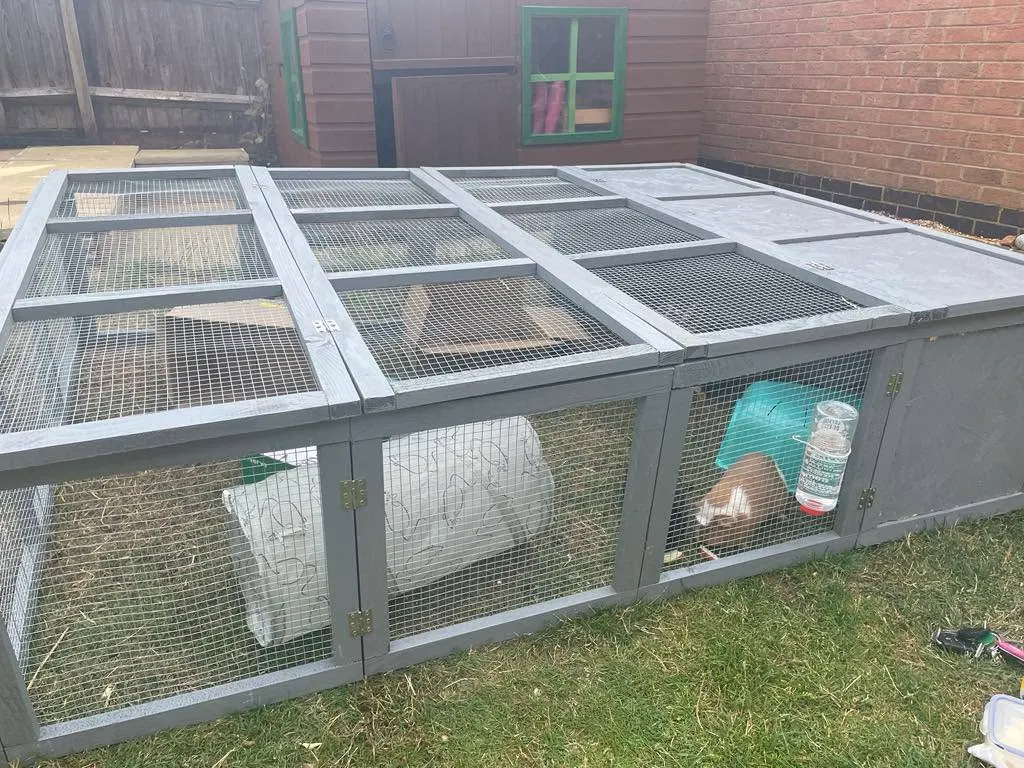
For example, a flat-pack hutch and run with a footprint of about 154 × 56 cm covers only 0.86 m² in total. Once you split that between a small upstairs sleeping box and a run underneath, neither part comes close to the 1 m² a pair needs in the enclosed hutch alone.
When you read a listing:
- Look for the internal floor size of the enclosed hutch, not just the overall dimensions. If it isn’t listed, ask the seller.
- Count only flat, single-level floor. Upper storeys and shelves are extras.
- Treat the run as bonus space for exercise and grazing, not part of the minimum.
Our size calculator tells you how much floor your group needs, and the cage size guide explains the numbers.
Are two-storey hutches OK for guinea pigs?
Usually not. A single-level hutch with a large floor is better than a tall one with the same total area. Many hutches are designed for rabbits and stack the living space over two levels joined by a ramp. Guinea pigs don’t climb much, and steep, narrow ramps can cause falls, especially for older or heavier pigs.
If you do buy a two-storey hutch, choose one with a wide, gentle ramp with grip strips and sides. Our guide to lofts and ramps has more detail.
What floor should a hutch and run have?
The hutch needs a solid floor raised off the ground, and the run needs protection against digging. RSPCA Australia advises avoiding wire floors, and PDSA recommends a weatherproof hutch raised off the ground.
- Hutch floor: it should be solid and raised so it stays dry. Avoid wire floors, which RSPCA Australia warns can cause injuries and foot infections.
- Run floor: many runs are sold with an “open floor for grazing”. That’s lovely for your pigs, but foxes and dogs can dig underneath. Either put the run on a paved area, peg mesh flat across the ground under the grass, or lay a mesh skirt around the outside edge so diggers are stopped. PDSA warns that hard surfaces like concrete can cause foot sores, so cover any paving with grass mats or bedding, and keep the run from getting too wet or muddy.
What mesh and latches keep predators out?
Strong welded mesh and latches that need two actions to open are the minimum. Chicken wire and simple turn-buttons are not enough for Australian foxes and dogs.
- Mesh: choose strong welded mesh, not chicken wire or thin hexagonal netting, which foxes and dogs can tear. If the mesh on a budget hutch looks flimsy, plan to replace or reinforce it.
- Snakes: in rural and bushland areas, standard mesh won’t keep snakes out. Use very fine mesh on the sleeping area at least, and close every gap.
- Latches: simple turn-buttons and sliding bolts can be nudged open. Look for latches that need two actions to open, or add carabiners or padlocks.
For how to set up the whole backyard against predators, see keeping guinea pigs outdoors safely.
What timber, roof and ventilation should a hutch have?
Look for thick, untreated timber, a waterproof sloped roof with an overhang, and good airflow without draughts at pig level. These decide how long the hutch lasts and how well it copes with Australian sun and rain.
- Timber: most budget hutches use soft fir or pine, which weathers quickly in Australian sun and rain. Thicker timber lasts longer. Avoid CCA-treated pine anywhere guinea pigs can chew it.
- Finish: if you paint or seal the hutch, use a water-based, non-toxic product on the outside only and let it dry completely before your pigs move in.
- Roof: it should be waterproof and slope so rain runs off, ideally with an overhang to shade the walls. An insulated or double roof helps on hot days.
- Ventilation: look for good airflow in the sleeping area without draughts at pig level.
Is the hutch easy to clean?
A good hutch lets you reach every corner without crawling in. Look for a roof or front that opens fully, a pull-out tray, and doors big enough to reach every corner.
Access matters because RSPCA Australia recommends cleaning at least 2–3 times a week and changing bedding completely at least once a week. Hutches you can only reach through a small door are hard to keep clean and make health checks awkward. Our cage cleaning guide covers the routine.
How much does an outdoor guinea pig hutch cost in Australia?
Under $300 usually buys a flat-pack hutch that’s too small for a pair, $300–$600 buys a bigger, sturdier hutch, and $600 and up buys large or custom-built hutches and walk-in runs. The prices in this table are rough Australian guides and change often.
| Price range | What you usually get | What to budget for |
|---|---|---|
| Under $300 | Flat-pack hutch and run, often two-storey, soft timber and light mesh | Usually too small for a pair. Expect to upgrade mesh and latches, or add a separate run |
| $300–$600 | Bigger hutches, sturdier timber, better doors | Check the enclosed floor is at least 1 m², and that the mesh is welded |
| $600 and up | Large or custom-built hutches and walk-in runs | Check shade, drainage and snake-proofing for your area |
Walk-in enclosures and aviary-style runs can also work well for guinea pigs, as long as they have a solid, weatherproof shelter inside, full shade, and mesh that’s dug in or secured along the ground.
Before you pay: quick checklist
Run through these seven checks before you buy any outdoor hutch.
- The enclosed hutch alone has at least 1 m² of flat floor for a pair
- Solid, raised hutch floor with no wire underfoot
- Welded mesh, not chicken wire, and secure two-step latches
- The run can be protected against digging
- Waterproof, sloped roof and good ventilation
- A roof or front that opens fully for cleaning
- A fully shaded spot ready in your yard, and a plan to bring your pigs in on hot days
Compare outdoor hutches with other types of housing in our comparison table, or see how specific products measure up in our researched picks.
Frequently asked questions
How big should an outdoor hutch be for 2 guinea pigs?
expand_more
The enclosed, weatherproof part of the hutch should have at least 1 m² of flat floor for a pair, before counting the run. RSPCA Australia recommends at least 2 m × 0.5 m for a pair, and the UK vet charity PDSA suggests a hutch of at least 1.5 × 1 m with a 2 × 1 m run attached.
How much does an outdoor guinea pig hutch cost in Australia?
expand_more
As a rough guide, flat-pack hutches under $300 are usually too small for a pair and need mesh and latch upgrades. Hutches from $300 to $600 are bigger and sturdier. Large or custom-built hutches and walk-in runs start at around $600. Prices change often, so check the enclosed floor size whatever you pay.
Where can I buy an outdoor guinea pig hutch in Australia?
expand_more
Outdoor hutches are sold at pet stores, hardware chains and on online marketplaces, and some builders make custom hutches. Wherever you buy, ask for the internal floor size of the enclosed hutch, not just the overall footprint, and check the mesh, latches and cleaning access before you pay.
Are two-storey hutches good for guinea pigs?
expand_more
Usually not. Many are designed for rabbits and split the space across two small levels joined by a steep ramp. Guinea pigs don't climb much, and narrow ramps can cause falls, especially for older or heavier pigs. A single-level hutch with a large floor is better than a tall hutch with the same total area.
Should a guinea pig hutch have a wire floor?
expand_more
No. RSPCA Australia advises against wire floors because they can cause injuries and foot infections. The hutch floor should be solid and raised off the ground so it stays dry. For a run with an open grass floor, peg mesh flat under the grass or add a mesh skirt so foxes and dogs can't dig in.
Will a hutch keep out foxes and snakes?
expand_more
Only if it's built for it. Choose strong welded mesh rather than chicken wire, which foxes and dogs can tear, and use latches that need two actions to open. Standard mesh won't stop snakes, so in rural and bushland areas use very fine mesh on the sleeping area at least and close every gap.
Want a properly sized cage without the DIY?
We're looking at bringing properly sized cages and C&C kits to Australia. Join the waitlist and tell us what you'd want.
This guide is general information to help you compare housing options. It isn't veterinary advice. If your guinea pig seems unwell, contact a vet experienced with exotic pets.