What size cage does a guinea pig need? Australian size guide
How much floor space guinea pigs need in square metres, by number of pigs. Based on RSPCA Australia guidance, with other welfare figures compared.
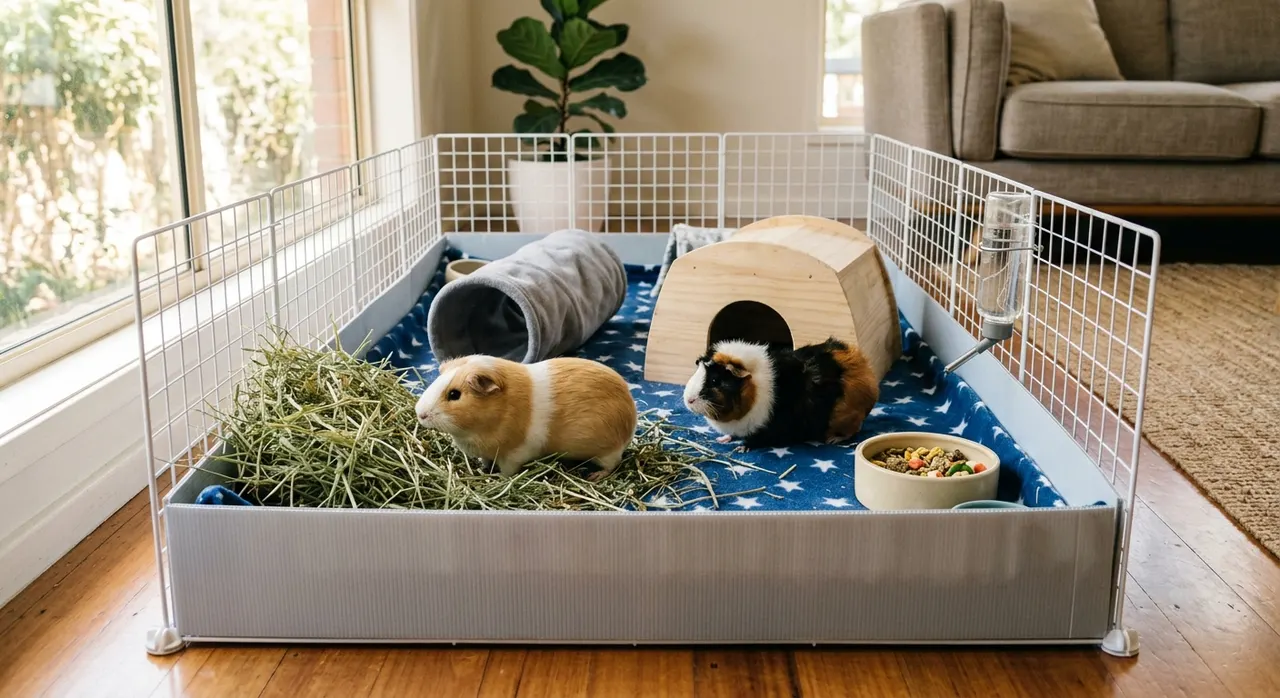
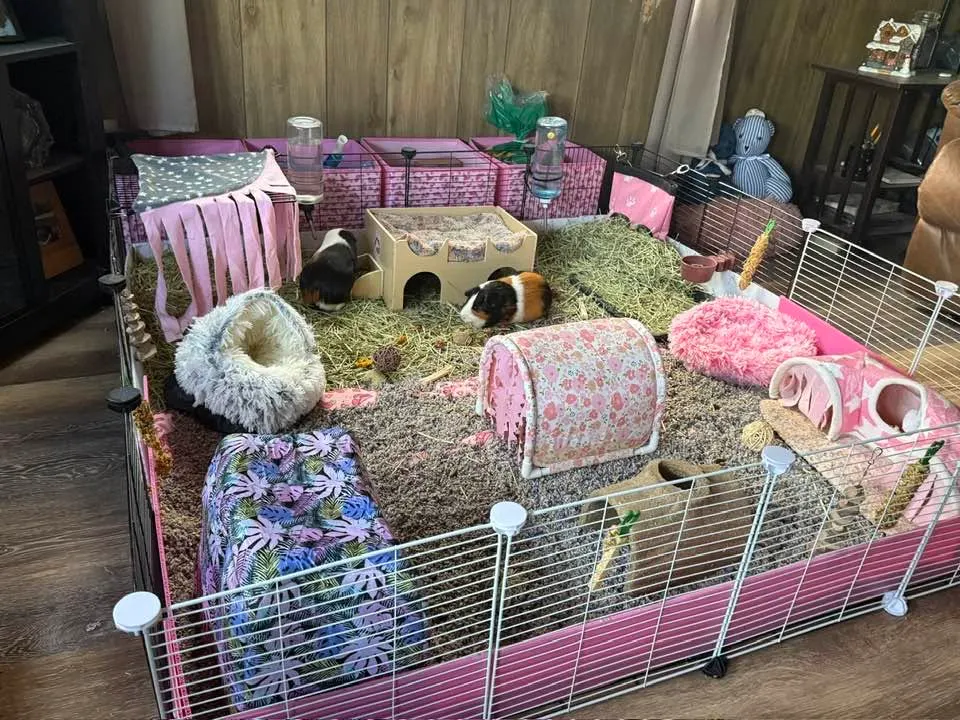
A pair of guinea pigs needs at least 1 m² of flat, continuous floor. RSPCA Australia recommends an enclosure of at least 2 m × 0.5 m and 30 cm high for two guinea pigs, and says bigger is better. A 2 × 4 grid C&C cage (about 71 × 142 cm) gives the same area. Many pet-shop cages offer only about 0.5 m².
Guinea pigs are ground-dwelling herd animals that like to run, “popcorn” (jump for joy) and patrol their patch. A cramped cage can lead to boredom, weight gain and squabbles between cage mates, so floor space is the most important thing to get right.
How much space do guinea pigs need?
A pair of guinea pigs needs at least 1 m² of flat, continuous floor, and more if you can manage it. That figure comes from RSPCA Australia, which recommends that a pair have an enclosure of at least 2 m × 0.5 m (10,000 cm²) and at least 30 cm high.
RSPCA Australia also says guinea pigs do better in a rectangular enclosure than a square one, because it gives them room to run. A 2 × 4 grid C&C cage (roughly 71 × 142 cm) has the same 1 m² area in a shape that fits most rooms.
Guinea pig cage size by number of pigs
This table combines RSPCA Australia’s guidance for a pair with the figures from Humane World for Animals (formerly the Humane Society of the United States), converted from square feet to square metres.
| Guinea pigs | Bare minimum | Recommended | Example C&C layout |
|---|---|---|---|
| 1 | 0.7 m² | 1.0 m² (and find them a friend) | 2 × 4 grids (71 × 142 cm) |
| 2 | 0.7 m² | 1.0 m² | 2 × 4 grids (71 × 142 cm) |
| 3 | 1.0 m² | 1.2 m² | 2 × 5 grids (71 × 178 cm) |
| 4 | 1.2 m² | 1.5 m² | 2 × 6 grids (71 × 213 cm) |
| 5+ | +0.25 m² per pig | +0.3 m² per pig | 3-wide layouts |
The 5+ row is our own extension of the same pattern, not a published figure. Boars (males) usually do better with the larger figure, because extra room helps prevent territorial disputes. Our cage size calculator works out the numbers for your group.
Only the flat, continuous, single-level floor. Lofts, ramps and shelves are nice extras, but they don't count toward the minimum. Guinea pigs live on the ground, so extra height and levels don't make up for a small floor. See lofts, ramps and two-storey cages.
What RSPCA Australia says compared with other guidance
Welfare organisations publish slightly different figures, which is why you’ll see different numbers quoted online. They all agree on the basics: a long, flat floor, solid flooring rather than wire, and bigger is better.
| Source | Space for a pair | Other key points |
|---|---|---|
| RSPCA Australia | At least 2 m × 0.5 m (1 m²), larger preferred | At least 30 cm high, rectangular shape, no wire floors |
| Humane World for Animals | 0.7 m² minimum, about 1.0 m² preferred | Walls at least 30 cm, no wire floors, glass tanks or plastic tubs |
| PDSA (UK vet charity) | Hutch at least 1.5 × 1 m, plus a 2 × 1 m run (no group size given) | Guidance for outdoor hutch setups, raised and weatherproof |
| RSPCA UK | “Large enough” to exercise, no fixed figure | About 30 cm of height, one more hide than there are guinea pigs |
A common mix-up: some sites say guinea pigs need “0.7 m² each”. The 0.7 m² figure is Humane World for Animals’ bare minimum (7.5 square feet) for one guinea pig, which it also lists as the minimum for a pair. It isn’t an RSPCA Australia figure. For Australian owners, 1 m² for a pair is the number to aim for.
Why most pet-shop cages are too small
Many cages sold in Australian pet stores are labelled as suitable for guinea pigs but offer only around 0.5 m² of floor, about half of what a pair needs. For example, a 101.5 × 51 cm rabbit cage gives just 0.52 m², which is less than the bare minimum for even one guinea pig.
Cage labels like “large” or “suits guinea pigs” don’t have to meet any standard, so always check the floor measurements yourself. Our researched picks compare the published floor sizes of real cages sold in Australia.
How to measure a guinea pig cage
To work out a cage’s floor space, multiply the internal length by the internal width in centimetres, then divide by 10,000 to get square metres.
- Find the internal floor dimensions in centimetres. Listings often quote the external size, so allow a little less.
- Multiply length by width. For example, 120 × 60 cm = 7,200 cm².
- Divide by 10,000 to get m². In this example, 7,200 cm² = 0.72 m², which meets the 0.7 m² bare minimum for a pair but not the recommended 1 m².
Already own a cage that comes up short? See is my guinea pig cage too small? for cheap ways to upgrade it.
Does cage length or height matter more?
Length matters more than height. Guinea pigs don’t jump or climb much, so tall, multi-storey cages are mostly wasted money. What they need is length to run. A long rectangle, such as 2 × 4 grids, beats a square of the same area. It gives a proper straight run and lets a shy pig keep its distance from a bossy one.
Walls of 30 cm or more are high enough for most guinea pigs, in line with both RSPCA Australia and Humane World for Animals. Add a lid if you have cats, dogs or small children.
Can floor time make up for a smaller cage?
No. Daily supervised floor time in a guinea pig-proofed room is great enrichment, but it doesn’t replace a properly sized cage. The cage is where guinea pigs spend most of their lives, including every night, so it needs to meet the size guidance on its own.
Next steps
- Use the size calculator for your exact group.
- Compare C&C cages, indoor cages and playpens and outdoor hutches.
- On a budget? See cheap guinea pig cages that still meet the guidance.
- Ready to set up? Follow our first cage setup checklist.
Frequently asked questions
What size cage do 2 guinea pigs need?
expand_more
Two guinea pigs need at least 1 m² of flat, continuous floor. RSPCA Australia recommends an enclosure of at least 2 m × 0.5 m (10,000 cm²) and at least 30 cm high for a pair, and says bigger is better. A 2 × 4 grid C&C cage, about 71 × 142 cm, gives the same 1 m² of floor.
What size cage do 2 male guinea pigs (boars) need?
expand_more
Give a pair of boars more than the minimum, ideally 1.2 m² or more, such as a 2 × 5 grid C&C cage (about 71 × 178 cm). Extra floor space, plus separate hides and food bowls, helps reduce territorial squabbles between males.
What size cage does 1 guinea pig need?
expand_more
Humane World for Animals gives about 0.7 m² (7.5 sq ft) as the bare minimum for one guinea pig. Aim for about 1 m², the same as a pair, because guinea pigs are herd animals and RSPCA Australia says they should ideally live with at least one other guinea pig.
Is a 120 × 60 cm cage big enough for 2 guinea pigs?
expand_more
Not quite. A 120 × 60 cm floor is 0.72 m², which only meets the bare minimum. It falls short of RSPCA Australia's guidance of 2 m × 0.5 m (1 m²) for a pair. A longer enclosure, such as a 2 × 4 grid C&C cage of about 71 × 142 cm, gives a pair the recommended space.
Do lofts and ramps count as floor space?
expand_more
No. Only flat, continuous, single-level floor counts toward a guinea pig's space needs. Guinea pigs live on the ground and prefer to run in straight lines, so lofts, ramps and extra storeys are enrichment extras. They don't make up for a small base.
How much space do 3 or 4 guinea pigs need?
expand_more
Based on Humane World for Animals figures converted to metric, three guinea pigs need about 1.0 m² at minimum and 1.2 m² recommended. Four need about 1.2 m² at minimum and 1.5 m² recommended. In C&C grids, that's roughly 2 × 5 grids for three and 2 × 6 grids for four.
Want a properly sized cage without the DIY?
We're looking at bringing properly sized cages and C&C kits to Australia. Join the waitlist and tell us what you'd want.
This guide is general information to help you compare housing options. It isn't veterinary advice. If your guinea pig seems unwell, contact a vet experienced with exotic pets.