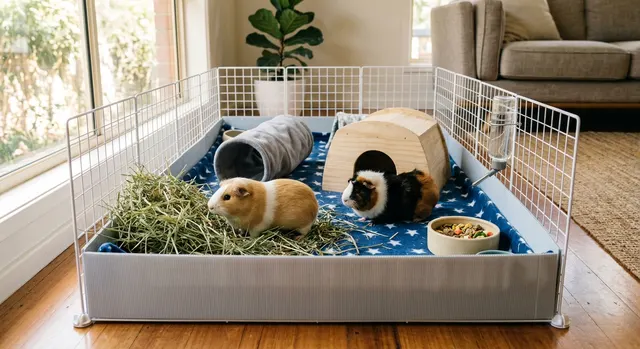
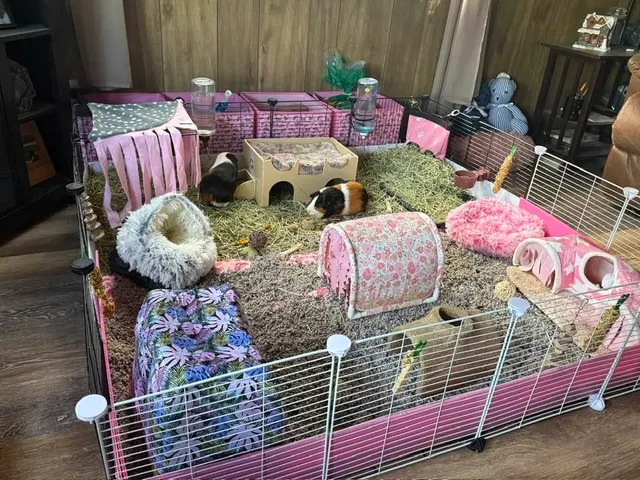
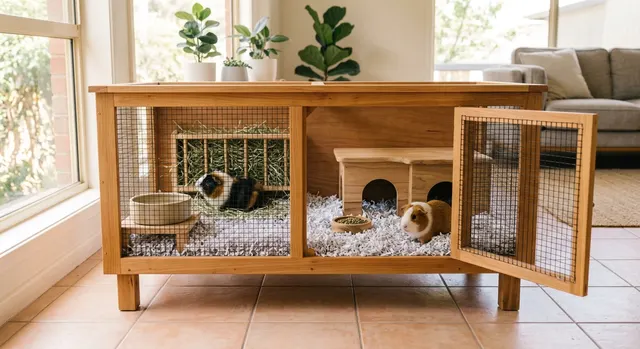
Lofts, ramps and two-storey guinea pig cages: are they safe?
Are multi-level guinea pig cages a good idea? How to make lofts and ramps safe, what angle a ramp should be, and why loft space doesn't count toward your cage's floor size.

Lofts and ramps are safe as an optional extra if the ramp is gentle, solid and grippy, has sides, and the loft is low with walls on every open edge. But guinea pigs live on the ground, so loft space doesn't count toward floor space. A pair still needs at least 1 m² of flat ground floor.
Tall, multi-storey cages are sold everywhere and can look like a great way to add space in a small home. For guinea pigs, it’s a bit more complicated. Here’s when a loft helps, when it’s a risk, and how to build one safely.
Do guinea pigs need a loft or second level?
No. Guinea pigs are ground-dwelling animals. They run, “zoom”, popcorn and patrol along the floor, but they don’t naturally climb, and they aren’t built for it. Their backs are long, their legs are short, and they can’t land well from a fall.
A loft can still be a good addition when it’s done well:
- It creates a separate “get-away” spot, which helps in bigger groups.
- It gives you somewhere to put a hay station or feeding area.
- Some confident pigs enjoy going up for a look around.
But it should always sit on top of a properly sized ground floor, never replace it.
Does a loft count toward cage size?
No. Only the flat, continuous, single-level floor counts toward the minimum. RSPCA Australia recommends a pair have an enclosure of at least 2 m × 0.5 m, and our size guide suggests at least 1 m² of floor for a pair.
This is where many tall pet-shop cages fall short. A three-level cage might have a total “platform area” that looks generous, but a bottom floor of only 0.4–0.5 m². Always check the bottom floor’s internal length and width. See is your guinea pig cage too small?
What makes a ramp safe?
- Gentle slope: roughly 25–30 degrees or less. A ramp about twice as long as the height it climbs is a good rule.
- Solid sides: walls along both edges so a nervous pig can't slip off the side.
- Grippy surface: Corflute or wood covered with fleece, carpet offcut or grippy matting. No bare wire or slippery plastic.
- Wide enough: at least the width of a guinea pig plus a bit, so two don't get stuck passing each other.
- Stable: fixed firmly at both ends with no gaps or wobble.
Avoid the steep, narrow wire ramps found in many ready-made cages. They’re hard on feet, and pigs often slide or fall off the side.
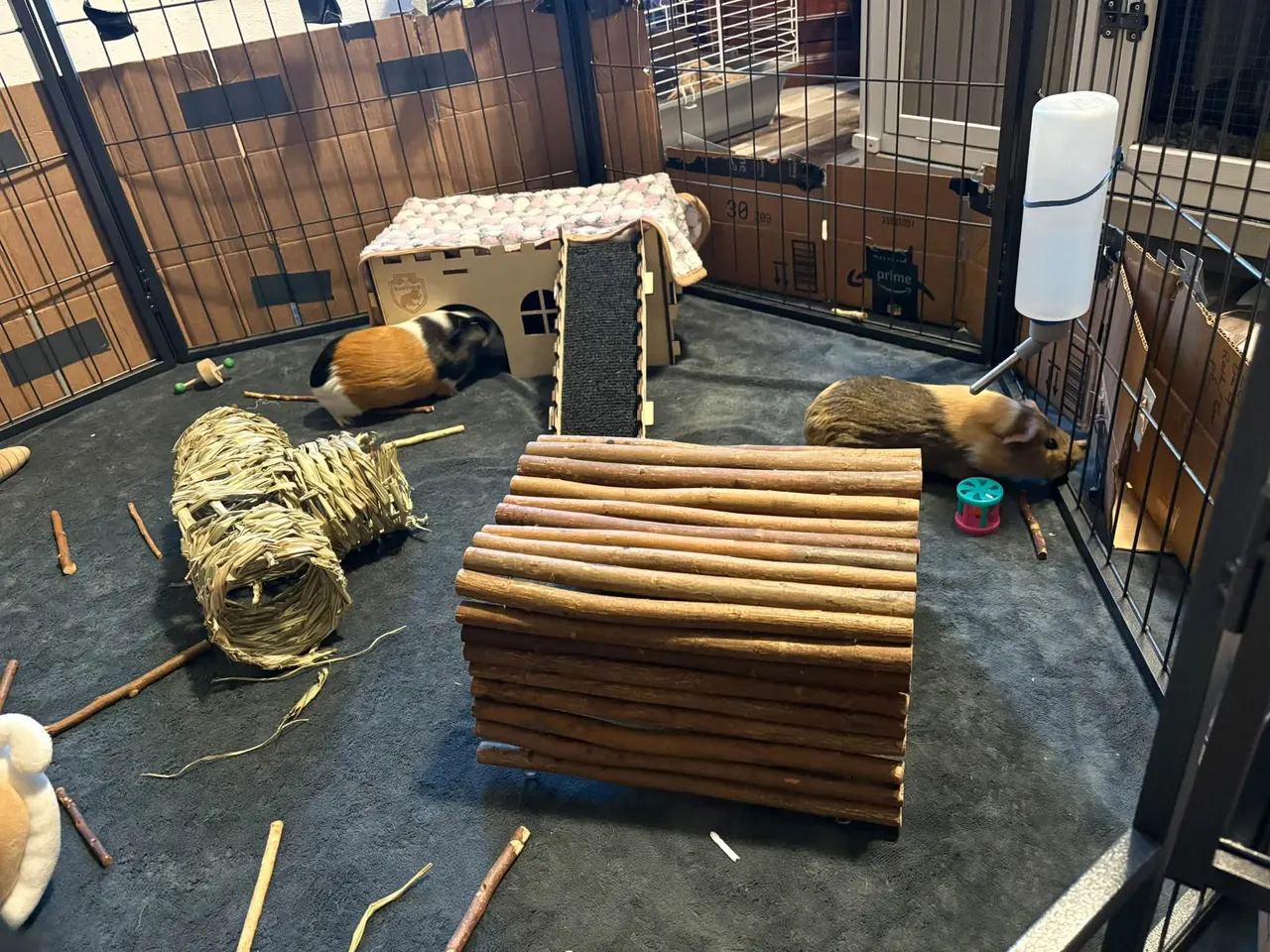
What makes a loft safe?
- Keep it low: around one grid high (about 35 cm) or less.
- Wall in every open edge: a Corflute lip or grid wall stops falls.
- Leave headroom underneath so pigs can walk under it comfortably. The space under a loft makes a great “cave”.
- Make it big enough to turn around in: a 1 × 2 grid loft (about 35 × 71 cm) is a practical minimum.
- Use a waterproof floor: Corflute with fleece or paper bedding on top, just like the main floor.
Who shouldn’t have a loft?
Skip lofts and ramps, or keep them very low, for guinea pigs that are:
- Elderly or arthritic
- Pregnant
- Overweight or recovering from illness
- Very young and still clumsy
- Blind or with poor eyesight
For these pigs, a single, flat, roomy floor is safest.
Building a loft in a C&C cage
C&C cages make lofts easy, because the grids act as supports. A simple layout:
- Build your main cage at least 2 × 4 grids. See the C&C cage guide.
- Clip a 1 × 2 grid panel horizontally one grid high at one end, as the loft floor.
- Line it with a folded Corflute tray so it’s waterproof.
- Add a Corflute or grid wall around the open edges.
- Fit a ramp with sides, about 70 cm long for a 35 cm loft, and secure both ends.
Our DIY cage guide covers cutting and folding Corflute. If you’re short on floor space, a bigger ground floor or a playpen for extra floor time will do more for your pigs than any number of levels.
Frequently asked questions
Do guinea pigs need a two-storey cage?
expand_more
No. Guinea pigs are ground-dwelling animals that don't climb much, so they need a long, flat floor more than height. A loft is a nice optional extra on top of a properly sized floor, not a replacement for one.
Does loft space count as floor space for guinea pigs?
expand_more
No. Only the flat, continuous, single-level floor counts toward the minimum size. A pair needs at least 1 m² of ground floor before you add any lofts or shelves.
Are ramps safe for guinea pigs?
expand_more
Ramps are safe if they are gentle, grippy, have solid sides, and don't lead to a high drop. Steep, narrow or slippery ramps and ramps without sides can cause falls. Guinea pigs have fragile backs and legs, and even a short fall can injure them.
What angle should a guinea pig ramp be?
expand_more
Keep ramps gentle, roughly 25 to 30 degrees or less. In practice, a ramp about twice as long as the height it climbs works well. For example, a 35 cm loft needs a ramp around 70 cm long.
How high should a guinea pig loft be?
expand_more
Keep lofts low, around one C&C grid high (about 35 cm) or less. The loft needs walls or a lip on every open edge so pigs can't fall off, and there should be enough headroom underneath for them to walk under comfortably.
Are multi-level pet shop cages good for guinea pigs?
expand_more
Usually not. Many tall, multi-storey cages sold for small animals have a small ground floor, steep wire ramps and open edges. They look roomy but give guinea pigs less of the space they actually use. Check the size of the bottom floor before you buy.
Want a properly sized cage without the DIY?
We're looking at bringing properly sized cages and C&C kits to Australia. Join the waitlist and tell us what you'd want.
This guide is general information to help you compare housing options. It isn't veterinary advice. If your guinea pig seems unwell, contact a vet experienced with exotic pets.