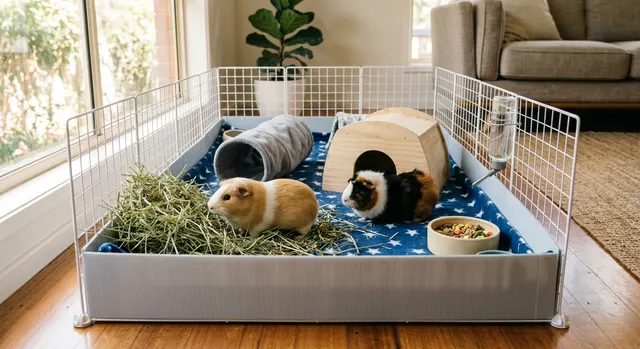
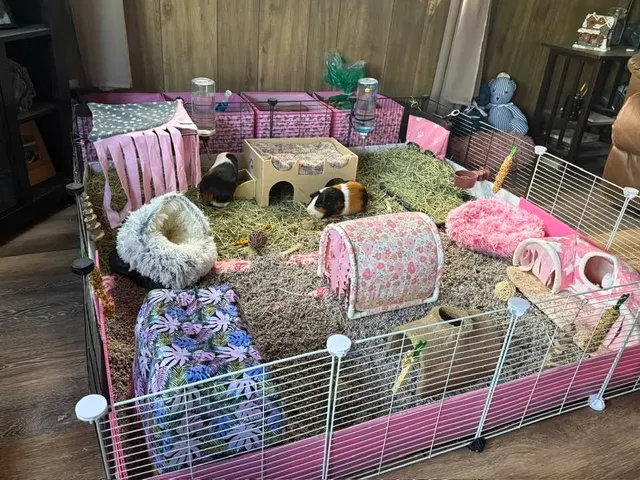
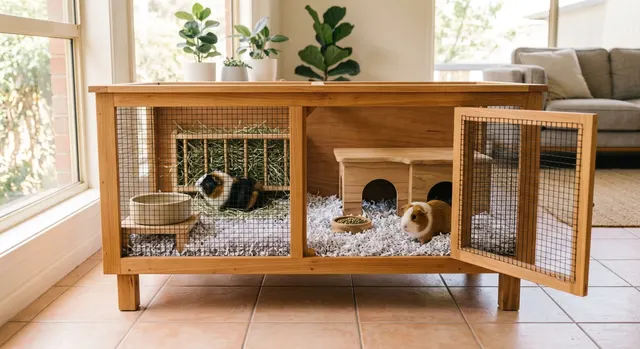
How to build a cheap DIY guinea pig cage (C&C) in an afternoon
Step-by-step instructions for a cheap 2 × 4 C&C guinea pig cage from storage grids and a Bunnings Corflute sheet, with a shopping list and measurements.
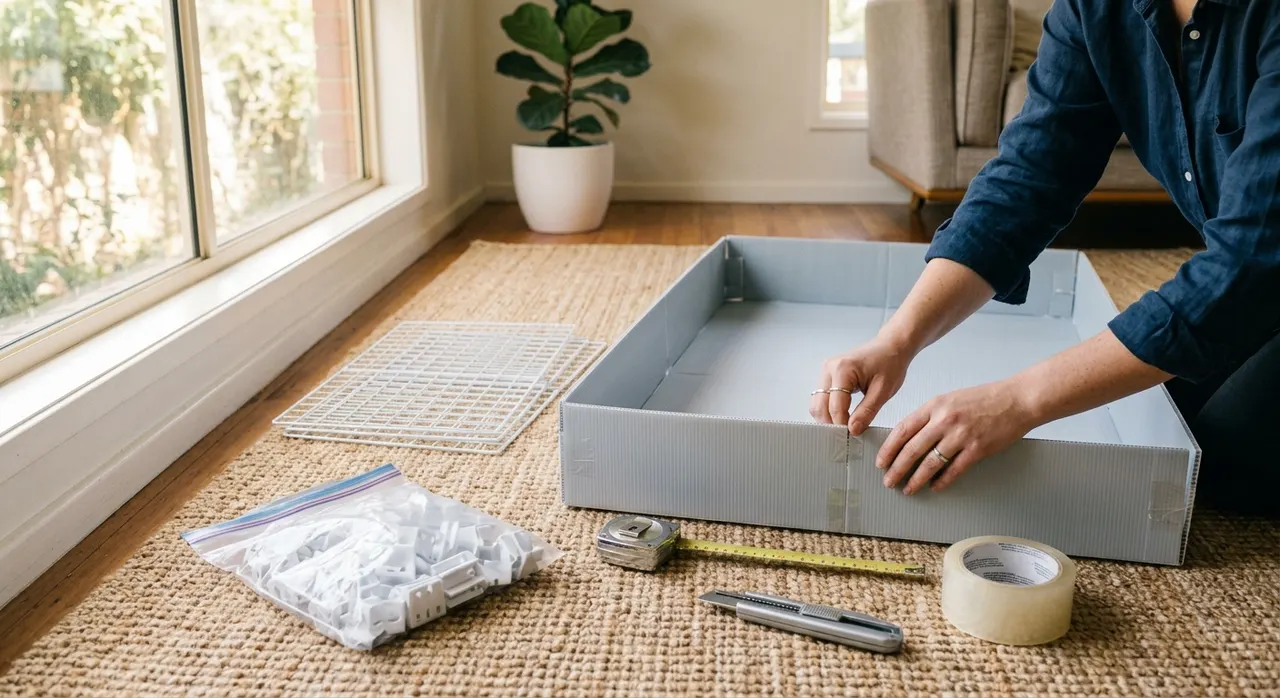
Build a 2 × 4 grid C&C cage, about 71 × 142 cm or 1 m², from 12 wire storage grids and one 2440 × 1220 mm Corflute sheet folded into a tray with 15 cm sides. Materials cost around $100 to $120 and it takes about an afternoon. That size meets RSPCA Australia's guidance of at least 2 m × 0.5 m for a pair.
A DIY C&C cage is the cheapest way to give a pair of guinea pigs enough floor space. This guide walks through the shopping list, the Corflute measurements and each build step.
What do you need to build a DIY guinea pig cage?
To build a 2 × 4 C&C cage you need 12 wire storage grids (plus 8 for a lid), about 30 connectors, one Corflute sheet, strong tape, a box cutter and a metal ruler. The total is usually around $100 to $120.
| Item | Quantity | Where to look |
|---|---|---|
| 35 cm wire storage grids | 12 for the walls, plus 8 for a lid | Homewares stores, online marketplaces, guinea pig suppliers |
| Grid connectors or cable ties | About 30 | Usually included with the grids, or any hardware store |
| Corflute sheet, 2440 × 1220 mm | 1 | Bunnings (some sheets are special order) |
| Strong tape (duct or packing tape) | 1 roll | Any hardware store |
| Box cutter and metal ruler | 1 each | Your toolbox |
Make sure the panels are about 35 cm square with small gaps between the wires. Some cheaper cube kits use smaller panels with wider gaps, and small guinea pigs can squeeze through them.
Why build a 2 × 4 cage?
A 2 × 4 grid layout gives about 1 m² of floor, the recommended size for two guinea pigs. RSPCA Australia recommends an enclosure of at least 2 m × 0.5 m (10,000 cm²) for a pair, with larger preferable and walls at least 30 cm high. Humane World for Animals gives a preferred size of about 1.0 m² for two pigs. Standard 35 cm grids are taller than that 30 cm minimum.
Step 1: Build the walls
Join 4 grids along each long side and 2 grids along each short side to make a rectangle about 71 × 142 cm. Put connectors at the top and bottom of every join. For a door, attach one grid on a long side along one edge only, so it swings open.
Step 2: Cut and fold the Corflute base
The Corflute base is a waterproof tray, about 172 × 101 cm before folding, that sits inside the grid walls with sides at least 15 cm high. A solid base matters because RSPCA Australia advises against wire floors, which can cause injuries and foot infections.
- Mark a rectangle on the Corflute: floor length + 2 × side height by floor width + 2 × side height. For 15 cm sides, that’s about 172 × 101 cm. A 244 × 122 cm sheet leaves plenty to spare.
- Cut it out with the box cutter, using the metal ruler as a guide.
- Measure 15 cm in from each edge and score along those lines, without cutting all the way through.
- At each corner, fold the square inwards to make a “hospital corner”, which keeps the tray waterproof. You can also cut the square out, but you’ll need to tape the join well.
- Fold all four sides up and tape the corners firmly on the outside.
Tip: cutting along the flutes (the channels inside the sheet) is much easier, so plan your cuts that way where you can.
Step 3: Put it together
Place the Corflute tray inside the grid walls so its sides sit flat against the grids. Add a grid lid if you have cats, dogs or curious toddlers. RSPCA Australia says a roof may be needed wherever guinea pigs are at risk from dogs, cats or birds of prey.
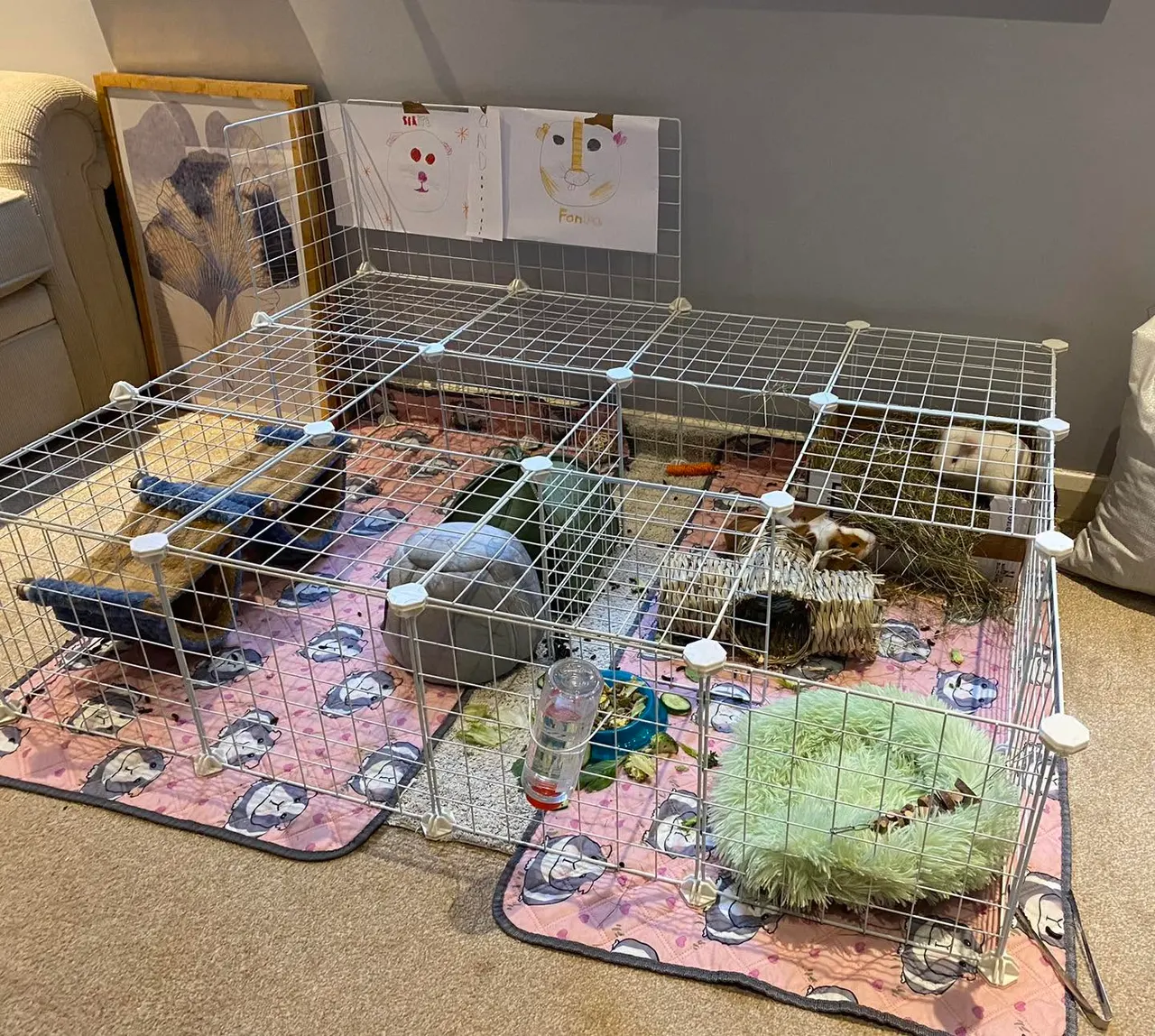
Step 4: Furnish it
A finished C&C cage needs bedding, a hide for each pig, plenty of hay, water and a food bowl.
- Absorbent, dust-free bedding or fleece liners, not wood shavings (see our bedding guide)
- One hide per guinea pig, ideally with two exits
- A large hay rack or hay pile, since RSPCA Australia calls grass hay the cornerstone of the diet
- Water bottles or a heavy bowl, one per pig
- A heavy ceramic food bowl
Set the cage on a stable, level surface in a cool, draught-free room, out of direct sun. RSPCA Australia says guinea pigs are comfortable at about 18–23°C. For the full setup, follow our first cage setup checklist.
How do you make a C&C cage bigger later?
To make a 2 × 4 C&C cage bigger, add 2 grids and a longer Corflute base to make a 2 × 5 layout of about 1.26 m². That suits a third pig or a pair of boars. Because C&C cages are modular, they grow with your herd. Our C&C cage guide has a size table for larger layouts.
Frequently asked questions
How much does it cost to build a DIY guinea pig cage in Australia?
expand_more
A 2 × 4 grid DIY C&C cage usually costs around $100 to $120 in materials. That covers a pack of 35 cm wire storage grids with connectors, one 2440 × 1220 mm Corflute sheet from Bunnings and a roll of strong tape. It gives a pair about 1 m² of floor.
How long does it take to build a C&C guinea pig cage?
expand_more
Most people can build a 2 × 4 C&C cage in an afternoon with basic tools: a box cutter, a metal ruler and tape. Joining the grids is quick. Measuring, scoring and folding the Corflute base takes the most care, so allow extra time for that step.
What size Corflute do I need for a 2 × 4 C&C cage?
expand_more
For a 2 × 4 grid cage of about 71 × 142 cm with 15 cm sides, cut a rectangle of about 172 × 101 cm. A standard 2440 × 1220 mm Corflute sheet from Bunnings is big enough, with plenty to spare. Score 15 cm in from each edge and fold the sides up.
Is a DIY C&C cage big enough for 2 boars?
expand_more
A 2 × 4 grid cage of about 1 m² meets the recommended size for a pair, but two boars often do better with more room. A 2 × 5 layout gives about 1.26 m². You can extend a C&C cage later by adding 2 grids and a longer Corflute base.
How many grids do I need for a DIY guinea pig cage?
expand_more
A 2 × 4 C&C cage needs 12 grids for the walls: 4 along each long side and 2 along each short side. Add 8 more grids if you want a lid, which is a good idea if cats, dogs or young children can reach the cage. You'll also need about 30 connectors or cable ties.
Can I use a DIY C&C cage outdoors in Australia?
expand_more
A C&C cage is best kept indoors. It has open sides and no roof, so it isn't weatherproof or predator-safe. RSPCA Australia says guinea pig housing should be a weatherproof, predator-safe shelter with an attached run, so use a purpose-built hutch and run outside and keep the C&C cage in a cool indoor room.
Want a properly sized cage without the DIY?
We're looking at bringing properly sized cages and C&C kits to Australia. Join the waitlist and tell us what you'd want.
This guide is general information to help you compare housing options. It isn't veterinary advice. If your guinea pig seems unwell, contact a vet experienced with exotic pets.